From Rapid Deployment to Coordinated Response

Modular counter-UAS architectures for temporary-area protection, on-the-move operations, and specialized hybrid response. Each solution path combines the sensing, command and response layers required by the mission

Choose by mission profile

Three Solution Paths

Start with the deployment model and operational objective, then select the appropriate sensors, command layer and response assets.

Reference architecture 01

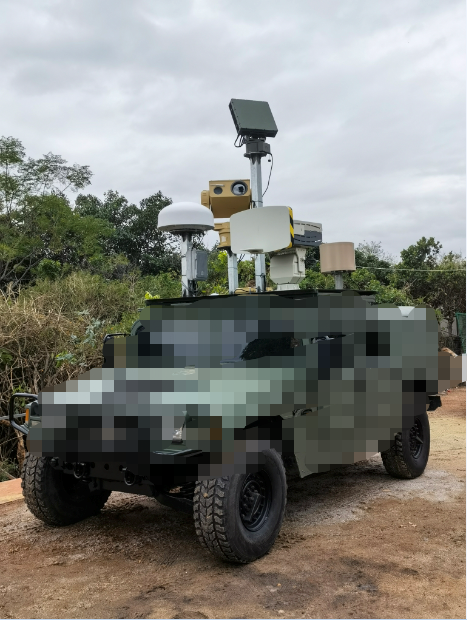
Rapid-Deployment Mobile Counter-UAS System

A modular system for locations where permanent infrastructure is unavailable or unnecessary. Detection, tracking, identification, command and response modules can be assembled around the vehicle or temporary command point according to the task.

Mission need Fast setup in temporary or changing protection areas
Architecture Modular sensing, command, verification and response
Operation Deploy, establish coverage, assess targets and respond
Best fit Temporary checkpoints, events and field operations
  • Supports detection-led operation rather than independent response activation.
  • Can combine RF, radar and EO assets according to the mission profile.
  • Modular configuration allows deployment scale to follow the protected area.
Reference architecture 02

On-the-Move Counter-UAS Operational System

A vehicle-integrated architecture that brings target detection, supported-model identification, tracking and response into one mobile platform. It is intended for missions where the protected asset or operational boundary changes during movement.

Detection distance ≥ 1,500 m under stated operating conditions
Response distance ≥ 800 m for jamming and navigation-deception modules
Jamming bands 915 MHz / 2.4 GHz / 5.8 GHz; optional bands available
Protection IP66 response module; −20°C to +55°C
  • Integrated power, detection, RF response and navigation-deception modules.
  • Navigation-deception reference supports GPS L1 and GLONASS L1.
  • Detection and recognition performance depends on the supported target library.
Specialized response architecture

AS333 Hybrid Jamming & Navigation Deception

AS333 combines directional RF-link suppression and satellite-navigation deception in one response platform. When coordinated with upstream detection, it supports drive-away, forced-landing and guided-response workflows without presenting the response device as an independent detection system.

Effective distance 3,000–5,000 m with line of sight
Navigation signals GPS L1 / GLONASS L1 / BDS B1I
RF response bands 915 MHz / 1.2 / 1.6 / 2.4 / 5.8 GHz
Environmental rating IP66; −20°C to +60°C
  • Directional antenna with 0–360° horizontal and −10° to +70° pitch control.
  • Supports drive-away, forced-landing and configurable defense-zone workflows.
  • Use as the response layer within a radar- or sensor-cued counter-UAS architecture.
Request AS333 integration guidance →

Shared operational logic

Detect to Respond

The three paths use the same decision-led operating logic while changing the deployment model and response layer.

01

Detect

Radar, RF or other sensing assets establish early warning.

02

Verify

Tracking and EO or protocol-level information support confirmation.

03

Assess

The operator evaluates location, behavior and protected-zone rules.

04

Respond

Activate an authorized RF or navigation-deception response.

05

Monitor

Observe target behavior and adjust the response when required.

Selection guide

Compare the Solution Paths

Use this comparison as an initial guide. Final architecture should follow a site and mission assessment.

Selection factor Rapid-deployment mobile On-the-move operational AS333 hybrid response
Primary role Temporary-area sensing and coordinated response Protection around a moving vehicle or convoy Specialized directional RF and navigation response
Deployment model Vehicle-supported, assembled at the operating location Vehicle-integrated and designed for mobile operation Fixed or platform-mounted response layer
Detection role Configurable radar, RF and EO combination Integrated detection and supported-model recognition Requires upstream detection and cueing
Response role Configured according to mission and authorization RF jamming and navigation-deception modules RF suppression plus navigation deception
Best fit Events, checkpoints and temporary field sites Mobile patrol, convoy and changing boundaries Defined sites requiring a specialized guided response

Published distances are reference values from the supplied technical materials. Actual performance varies with target type, line of sight, electromagnetic environment, antenna configuration and local operating conditions.

Representative contexts

Where These Architectures Fit

These are representative operating contexts rather than named customer case studies.

Temporary Events

Rapidly establish a controlled protection area without permanent infrastructure.

Mobile Patrol

Support changing routes, moving assets and field-security operations.

Critical Sites

Integrate specialist response assets with existing detection and command layers.

Layered Defense

Combine complementary sensors and authorized response methods in one workflow.

Build the Right Architecture for the Mission

Share the protected area, deployment model and expected threat profile. Our technical team can help define the sensing, command and response layers required for the project.

Request Solution Consultation